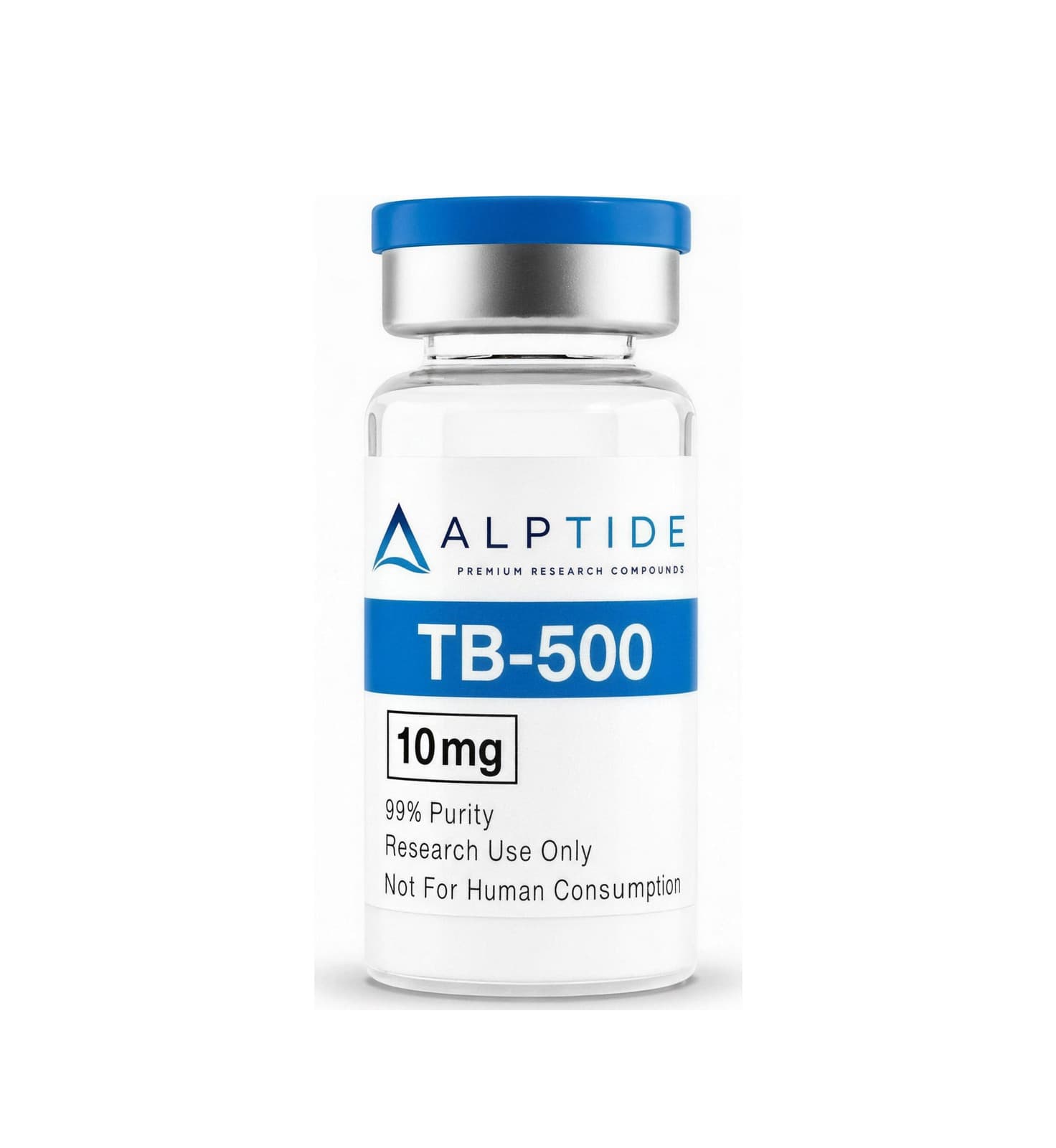
Synthetic research peptide catalogued for repair-and-recovery pathway studies.
- Dose
- 10 mg
- Batch
- 268002
TB-500
Ac-Leu-Lys-Lys-Thr-Glu-Thr-Gln-OH (N-acetylated thymosin β4 actin-binding fragment, residues 17–23) · Ac-LKKTETQ
For research purposes only — This compound is not FDA approved. All data presented is from clinical trials for educational reference.
Synthetic research peptide catalogued for repair-and-recovery pathway studies.
Members get 10% off every order, on top of volume pricing — become a member with a free account.
Volume savings are applied automatically at checkout. Larger orders: support@alptide.at
- Lab
- Janoshik Analytical
- Purity
- 98.853%
- Methods
- HPLC · LC-MS
- Tested
- Oct 6, 2026
For laboratory research use only. Not for human consumption.
Technical specifications
- Type
- Peptide
- Scientific name
- Ac-Leu-Lys-Lys-Thr-Glu-Thr-Gln-OH (N-acetylated thymosin β4 actin-binding fragment, residues 17–23)
- Amino acids
- 7
- Sequence
- Ac-LKKTETQ
- Molecular weight
- 889.0 g/mol
- Formula
- C38H68N10O14
- CAS
- 885340-08-9
- Origin
- Synthetic N-acetylated copy of the LKKTETQ actin-binding motif at residues 17–23 of human thymosin β4 (UniProt P62328); not the full 43-residue protein.
- Lyophilized (powder)
- -20°C · stable long-term; -80°C for multi-year storage. Keep sealed and desiccated, protected from light.
- Reconstituted
- 2-8°C · use within ~30 days; for longer holds aliquot and freeze at -20°C and avoid repeated freeze-thaw cycles.
- Room temperature
- The lyophilized powder tolerates brief ambient shipping excursions of several days. In solution the peptide is not stable at room temperature — unprotected short peptides undergo hydrolysis and, in biological matrices, rapid aminopeptidase cleavage (LC-MS work on TB-500 in equine plasma and urine reports a series of truncated metabolites alongside the intact peptide). Do not store reconstituted vials at ambient temperature.
Peer-reviewed research
Published research and registered trials involving this compound. Provided for educational reference only — none of it is a claim about this product.
- Proceedings of the National Academy of Sciences U.S.A.Complete amino acid sequence of bovine thymosin beta 4: a thymic hormone that induces terminal deoxynucleotidyl transferase activity in thymocyte populationsLow TL, Hu SK, Goldstein AL1981DOI: 10.1073/pnas.78.2.1162PMID: 6940133
- The FASEB JournalThe actin binding site on thymosin beta4 promotes angiogenesisPhilp D, Huff T, Gho YS, Hannappel E, Kleinman HK2003DOI: 10.1096/fj.03-0121fjePMID: 14500546
- Wound Repair and RegenerationThymosin beta 4 and a synthetic peptide containing its actin-binding domain promote dermal wound repair in db/db diabetic mice and in aged micePhilp D, Badamchian M, Scheremeta B, Nguyen M, Goldstein AL, Kleinman HK2003DOI: 10.1046/j.1524-475x.2003.11105.xPMID: 12581423
- Journal of Investigative DermatologyThymosin beta4 accelerates wound healingMalinda KM, Sidhu GS, Mani H, Banaudha K, Maheshwari RK, Goldstein AL, Kleinman HK1999DOI: 10.1046/j.1523-1747.1999.00708.xPMID: 10469335
- NatureThymosin beta4 activates integrin-linked kinase and promotes cardiac cell migration, survival and cardiac repairBock-Marquette I, Saxena A, White MD, DiMaio JM, Srivastava D2004DOI: 10.1038/nature03000PMID: 15565145
- The FASEB JournalBiological activities of thymosin beta4 defined by active sites in short peptide sequencesSosne G, Qiu P, Goldstein AL, Wheater M2010DOI: 10.1096/fj.09-142307PMID: 20179146
- Journal of Chromatography ADoping control analysis of TB-500, a synthetic version of an active region of thymosin β₄, in equine urine and plasma by liquid chromatography-mass spectrometryHo ENM, Kwok WH, Lau MY, Wong ASY, Wan TSM, Lam KKH, Schiff PJ, Stewart BD2012DOI: 10.1016/j.chroma.2012.09.043PMID: 23084823
- Annals of the New York Academy of SciencesA randomized, placebo-controlled, single and multiple dose study of intravenous thymosin beta4 in healthy volunteersRuff D, Crockford D, Girardi G, Zhang Y2010DOI: 10.1111/j.1749-6632.2010.05474.xPMID: 20536472
More in Repair
BPC-157
10 mg / vial
Synthetic research peptide catalogued for repair-and-recovery pathway studies.
AHK-Cu
50 mg / vial
Copper-complexed peptide research material catalogued for tissue-model studies.
BPC-157 + TB-500
20 mg / vial
Combined research-peptide blend catalogued for repair-and-recovery pathway studies.
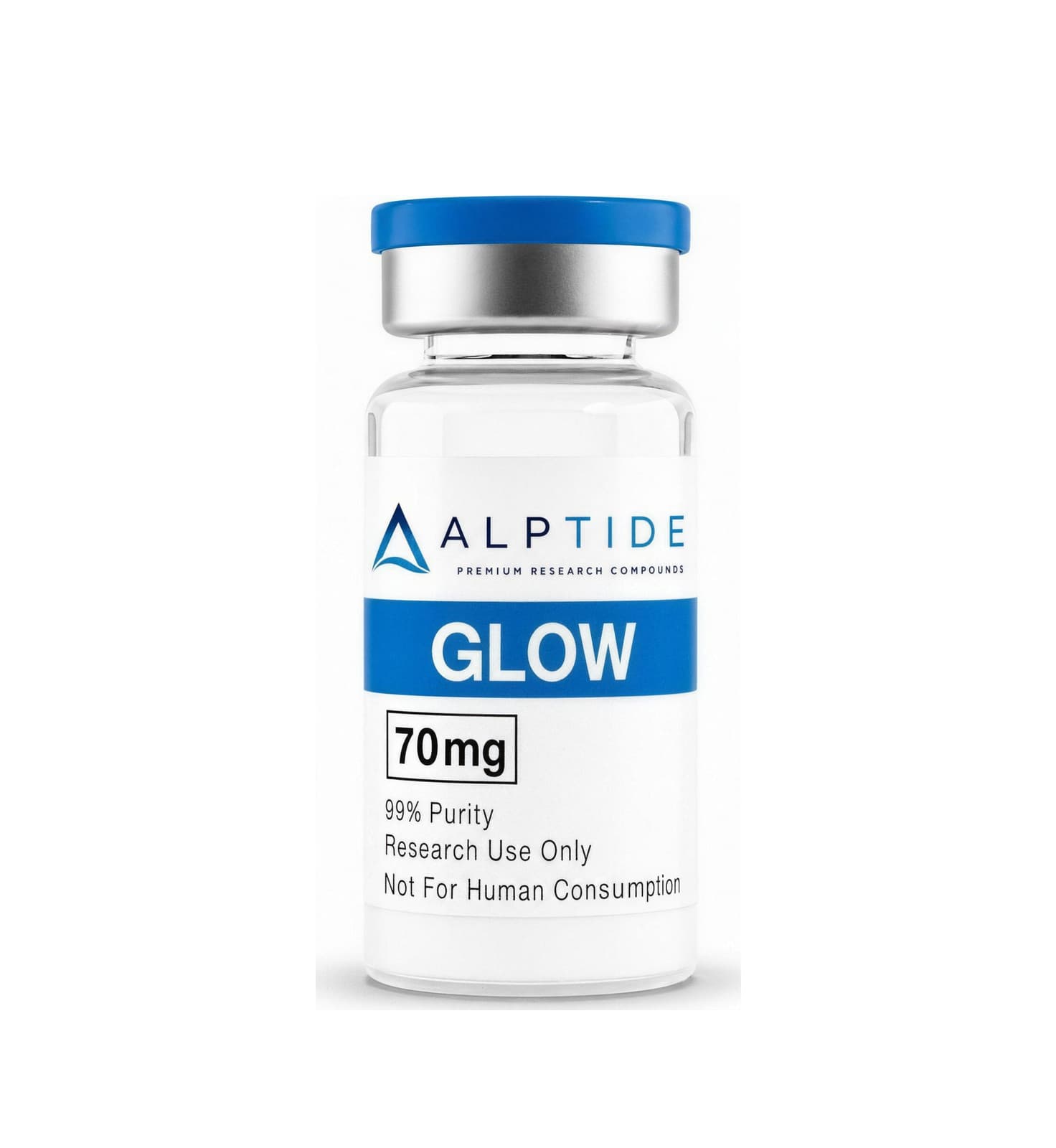
Glow Blend
70 mg / vial
Named multi-peptide research blend catalogued for repair-and-recovery studies.